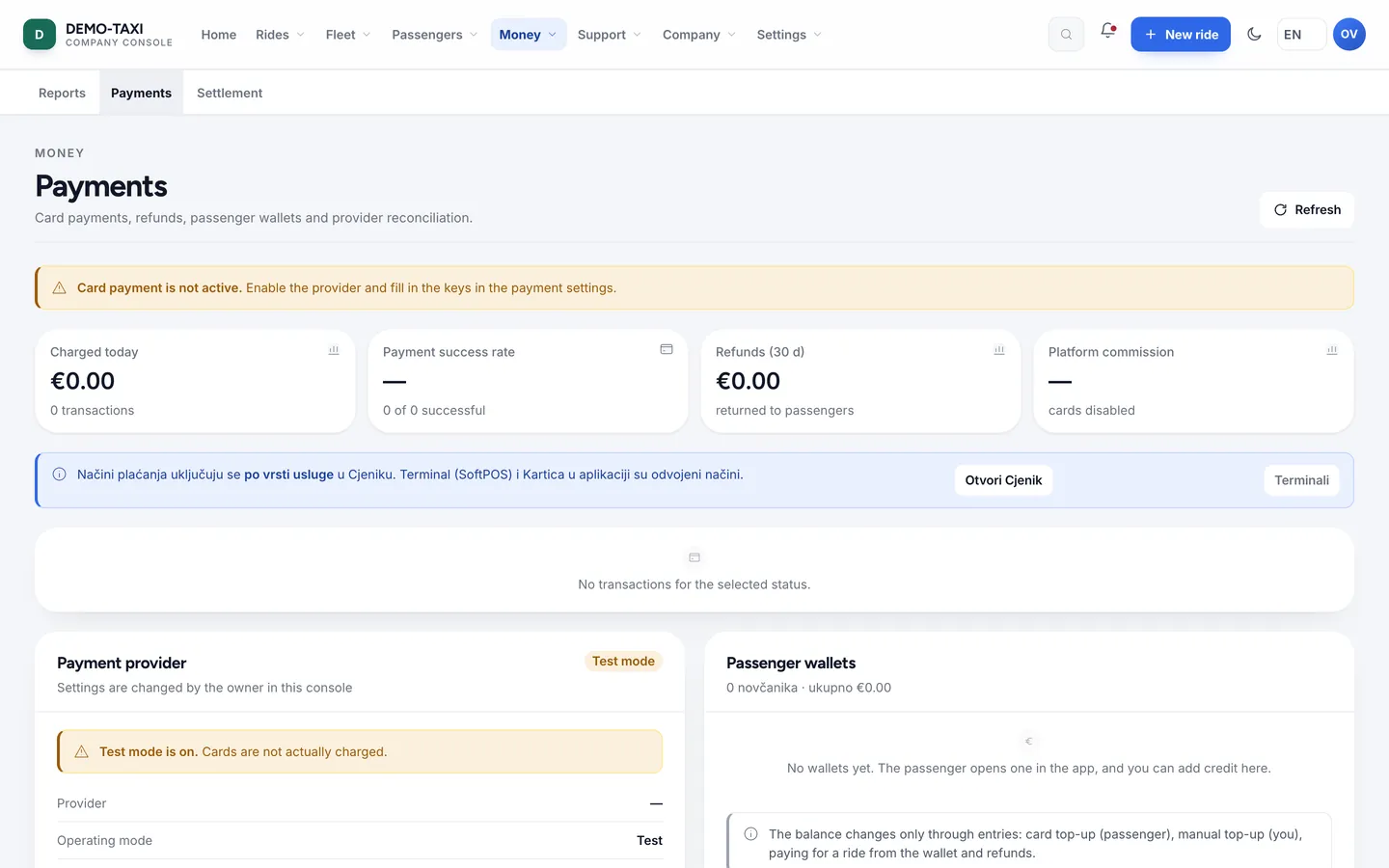
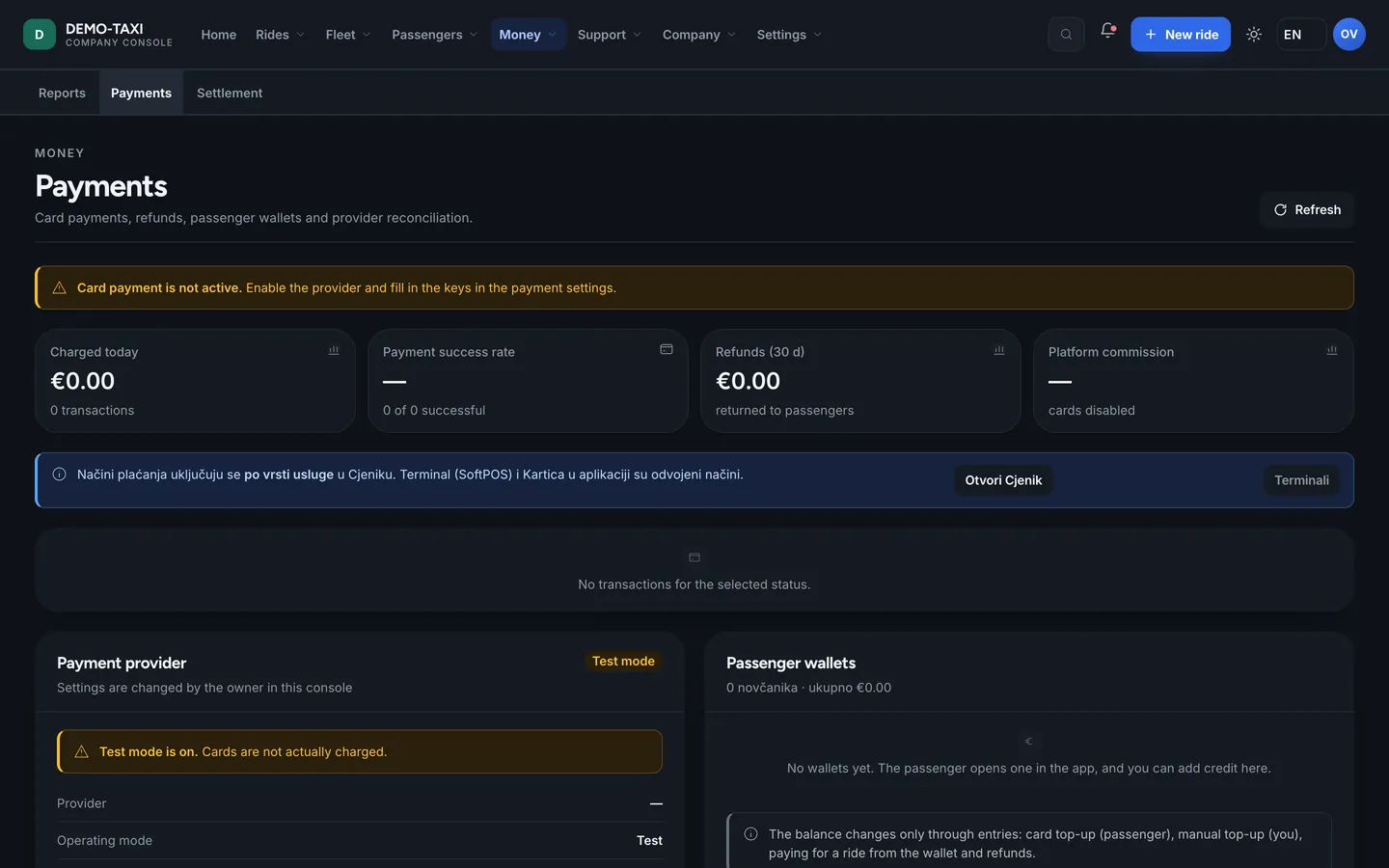
How people pay and what the passenger gets
Cash, card in the app, card on the driver’s phone, wallet and company accounts — with a fiscal receipt issued on its own, by the country’s rules.
Payment is the most sensitive part of the business: it shows whether the company earned what it thinks it earned. That is why the system does not allow an amount to be “skipped” — every ride has a payment method and every finish leaves a record.
Ways a passenger can pay
| Method | How it works | What the company sees |
|---|---|---|
| Cash | The passenger pays the driver at the end; the driver confirms receipt. | The money is with the driver, so settlement shows it as their obligation or earnings. |
| Card in the app | The card is entered once and charged automatically at the end of the ride. | A transaction with status; the money never passes through the driver. |
| Card on the driver’s phone (SoftPOS) | The driver charges on their phone, with no separate terminal, where the provider supports it. | The payment enters the same settlement as a card payment from the app. |
| Wallet | The passenger tops up credit in advance and pays from it; gift credit can be added. | Credit, usage and balance per passenger. |
| Company account | For corporate clients: rides collect and are paid monthly, with a cost centre. | A monthly statement per client company and cost centre. |
| Terminal in the vehicle | A classic POS device, if the company has one; the ride closes as paid by card. | Same as card, noted as paid through the terminal. |
The receipt the passenger gets
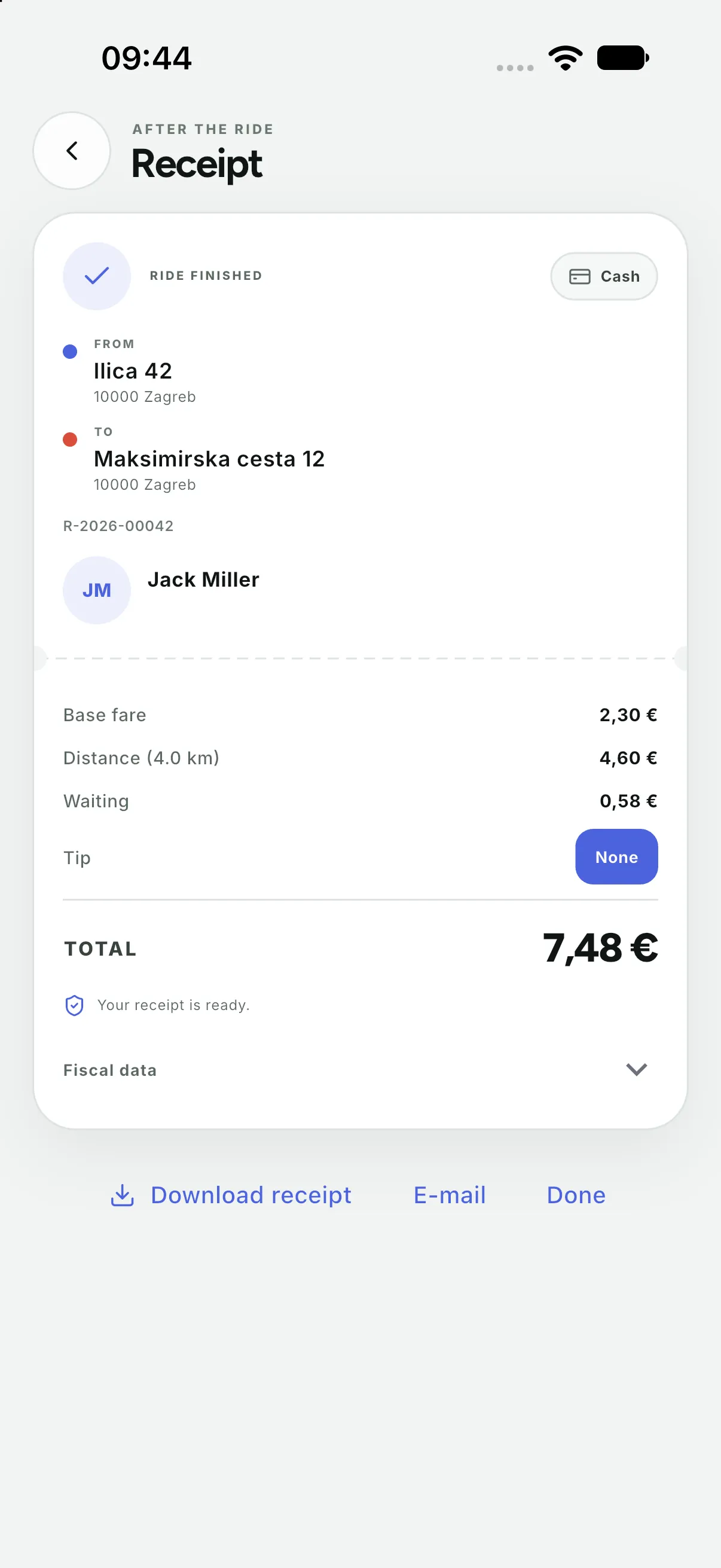
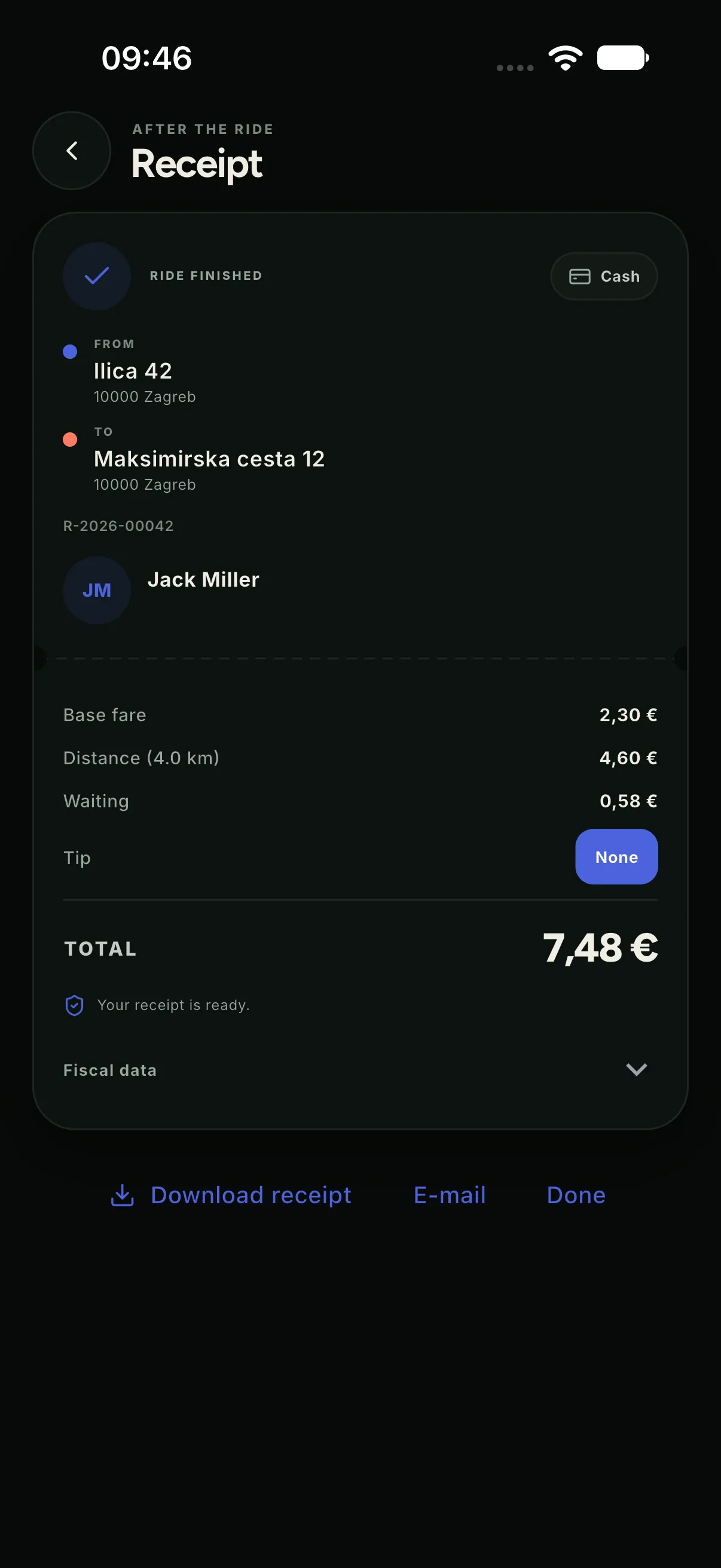
A receipt is produced with the ride and carries the lines (base fare, distance, waiting, tip), the total, the payment method and the company’s details. Where the country requires it, fiscal data is there too — receipt number, premises and device marks and the issuer’s confirmation.
- The passenger sees the receipt in the app and can e-mail it or share it as a PDF.
- The company sees the same receipt in Settlement and can print it.
- A receipt cannot be “re-issued with a different amount”; a correction is a storno plus a new receipt.
Card payment providers
The company chooses the provider and opens its own account with them; the platform supports it without code changes. Keys stay on the company server, and the console only shows whether the link is up.
| Provider | What it is used for |
|---|---|
| Stripe | Card in the app and wallet; the usual choice for online payment. |
| Nexi | Card payment and physical terminals, common in Croatia. |
| Viva.com | Card payment and SoftPOS on the driver’s phone. |
Refunds and corrections
- A refund is started from Payments with a reason; history keeps who started it and when.
- A cash refund cannot be executed by the software — it is recorded as a correction in settlement.
- A tip is part of the receipt but not part of the company’s revenue; settlement shows it separately.
Fiscalisation by country
Rules differ: in Croatia a receipt must be confirmed by the tax authority before the passenger gets it, while other countries have their own rules. That is why the mode (test or production) is not a hidden setting — it is visible in the console and required before the first ride.