Everything that can be switched on
Eight things every company has from day one and eleven that are added when needed — each with what it does, who needs it and where it shows up.
A module is a piece of work a company has or does not have. One company drives street rides only and does not need a passenger wallet; another lives on hotel contracts and cannot work without corporate accounts. That is why some things are switched on, and some are always there.
Switching on does not need a new app versionThe platform switches a module on at the company’s request and it applies immediately — the apps ask the server what the company has. The company simply sees it as part of its plan, with no clicks in any admin. Switching one on is not a reason for a store release, nor for telling drivers about “a new app”.
What every company has
This is not switched on and not billed separately — without it a company could not work.
| What | What it gives you |
|---|---|
| Passenger app | Passengers book, follow the ride and pay. Without it a company has no booking channel of its own. |
| Driver app | Drivers get offers, navigation, shift and earnings. Without it rides are assigned “by phone”. |
| Company console | The office sees rides, fleet, prices, money and support in one place. |
| Prices, zones and vehicle classes | The price is computed by the company’s rules, not “by the driver’s feel”. |
| Dispatch and fleet map | A ride finds a driver automatically or a dispatcher assigns one by hand; the map shows where everyone is. |
| Reports and settlement | You know what was earned and who is owed what — without spreadsheets patched by hand. |
| Fiscalisation and e-invoice | The receipt follows the country’s rules, with fiscal data where required. |
| Roles and notifications | A dispatcher does not see money, accounting does not touch the board; passengers and drivers are notified in time. |
What is added when needed
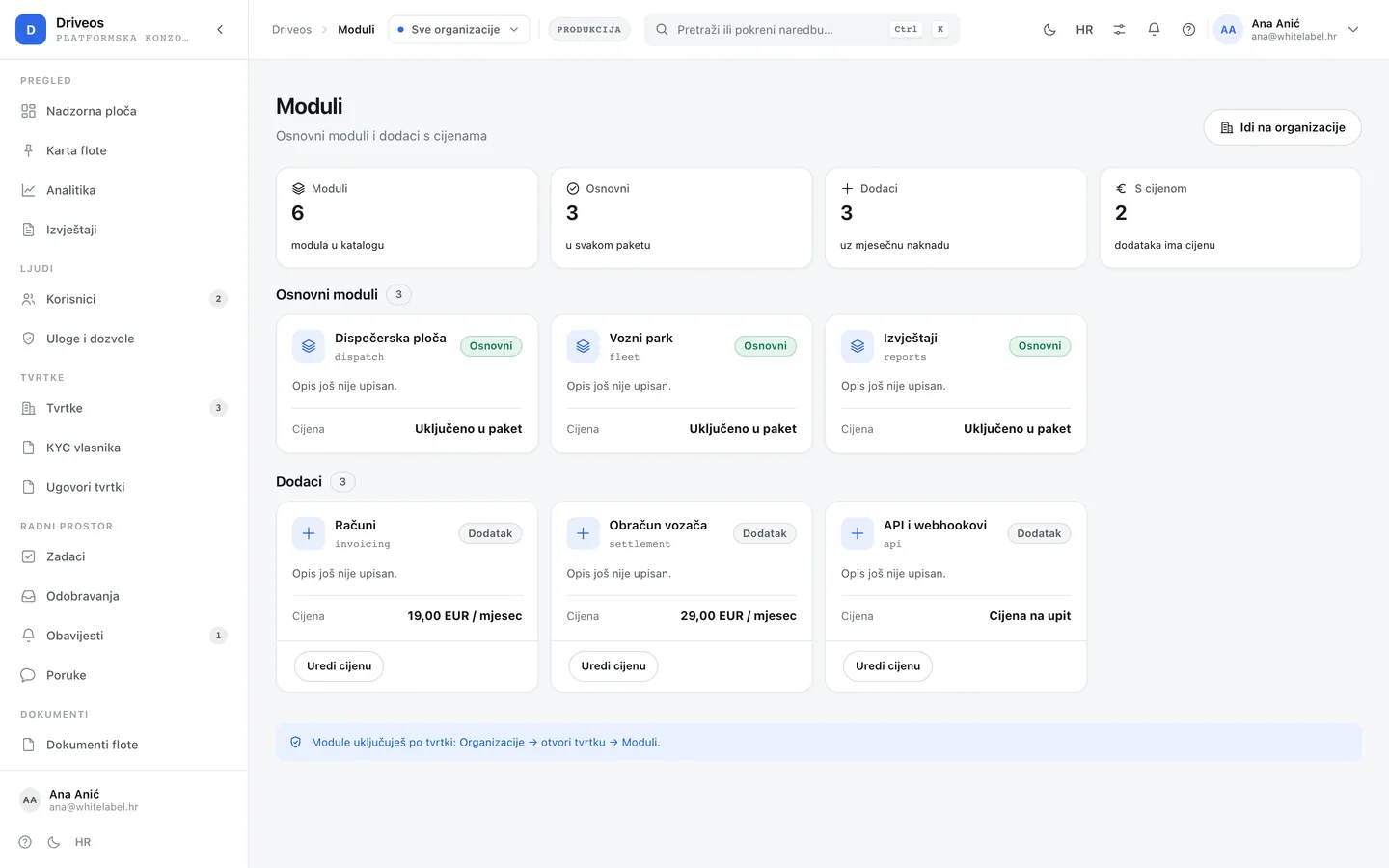
Add-ons are switched on per company and visible in the console under Company → Add-ons. Most are paid monthly; one is paid once. Some can also have a date until which they apply.
| Add-on | What it does | Who needs it |
|---|---|---|
| Operator console and call centre | Phone bookings, a call list, linking a call to a ride and transfers. It works without telephony too — then it is just entering a booking from the call. | Companies that still live on the phone, hotels, bigger cities |
| Web booking | Booking on the company’s website for guests, hotels and partners, without installing an app. | Hotels, apartments, tourist towns |
| Corporate accounts | Corporate clients pay monthly; rides go on the account, with a cost centre and approval. | Companies that drive employees or clients |
| Passenger wallet | Credit and top-ups in advance, so the passenger pays from the wallet without a card each time. | Companies wanting loyalty and faster payment |
| Promo codes and gift credit | Discount or gift coupons with expiry and limits; you see how often they were used. | Campaigns, seasons, partners |
| Scheduled and recurring rides | A ride booked for 5 a.m., or every Monday — without re-entering it. | Airports, hospitals, regular clients |
| Driver billing and plans | Commission, balance and payouts per driver instead of a verbal agreement. | Any company with more than a few drivers |
| Driver bonuses | A reward for night rides, a weekly target or rating — with a budget and approval; it enters settlement. | Companies encouraging drivers to work more |
| Next ride while busy | A driver receives the next ride while still on the current one, so there is no idle gap between two. | Cities with high demand |
| API access | Keys and notifications for connecting with a hotel, a reservation system or the company ERP. | Companies with software of their own |
| Store launch support | Help publishing the apps to Google Play and the App Store. Paid once. | Companies publishing an app for the first time |
What happens when a module is off
| Where | What you see |
|---|---|
| Server | A “module is not enabled” answer and a message in Croatian; the data stays in the database. |
| Company console | The page and the navigation item are hidden — nobody looks for what is not there. |
| Platform console | The module stays visible, marked as not enabled for the company. |
| Apps | Part of the interface is not shown (e.g. the wallet in payments), so the passenger never sees an option that does not work. |
Expiry is not deletionA module enabled with an expiry date stops applying at midnight of that day in the company’s time. History stays: rides, receipts and settlement from the period when it worked do not change.